DESIGN
The drawing must be one continuous line
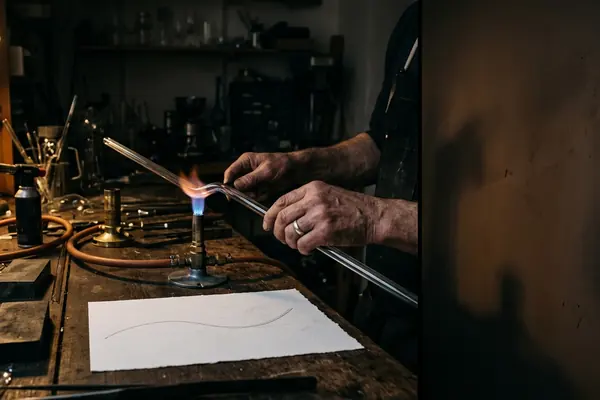
The maker traces the shape onto paper first. Letter forms must be continuous so the gas can flow evenly from one end of the tube to the other.
Design rules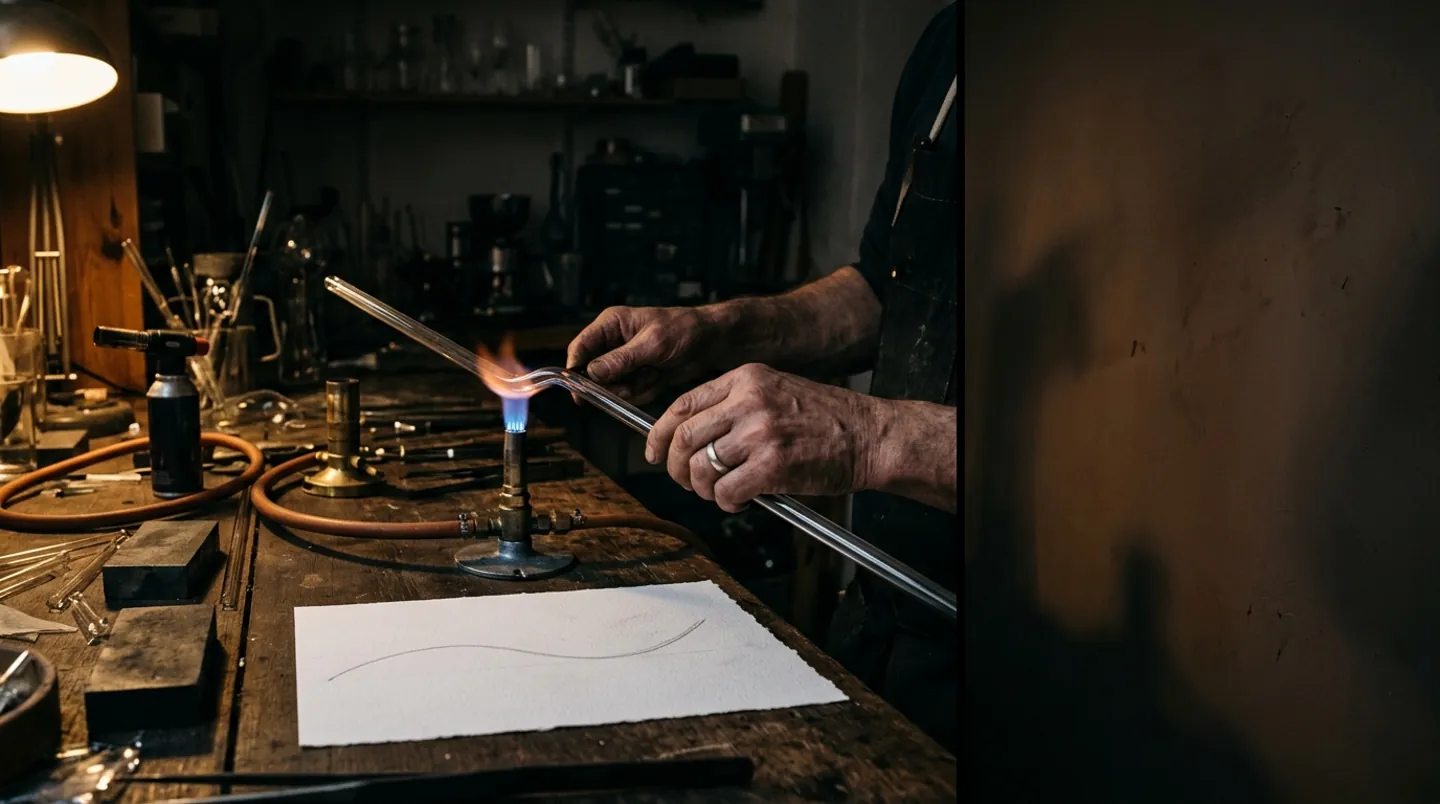
HOW A NEON SIGN IS DESIGNED AND MADE
GLOW since 1910
AI-generated image, not a photograph of a real person or place.
Every neon sign starts as a drawing, and the drawing has to obey the glass.
A sign-maker traces the design full size, bends tubing over a flame to match it, then pumps out the air and fills the tube with gas. The gas, and sometimes a coating inside the glass, decides the colour you see.
THE SHORT ANSWER
A neon sign is a sealed glass tube with gas inside.
Shape, gas and coating are all decided at the drawing stage.
DESIGN
The maker traces the shape onto paper first. Letter forms must be continuous so the gas can flow evenly from one end of the tube to the other.
Design rulesTRUE NEON
Neon is a colourless gas that shows a red-orange glow when an electrical discharge passes through it. Other colours use other gases or coloured glass.
Pick a colourOTHER COLOURS
Argon starts the arc, mercury vapour then gives off ultraviolet light, and a phosphor coating inside the tube turns it into blue, green or yellow.
Where it began
FOUR RULES FOR A NEON DESIGN
Whether you sketch by hand or on a computer, the design has to become a real bent tube. These rules come from how signs are actually made.
Letters and shapes must link up so the gas can flow evenly from one end of the tube to the other.
Sections of tube are painted black or another opaque colour to make the space between joined letters or forms.
Clear red is neon alone. Most blues, greens and yellows use argon and mercury with a coloured phosphor coating.
Argon is not reliable in the cold, so a neon, argon and mercury mix is used outdoors to work more reliably in cold weather.
TWO NUMBERS WORTH KNOWING
One figure on the classic gas mix,
one on how long a tube can last.
99.5%
Neon in a classic red tube
The classic neon lamp holds a mixture of neon (99.5%) and argon. Argon helps strike the arc; once warm, current flows through the neon and it glows.
GAS MIX · EDISON TECH CENTER
25,000 hours
Typical lamp life
Neon lamps are listed at about 25,000 hours, with about 50 lumens per watt for red and 65 for green. A well-made tube can last for decades.
LIFESPAN · EDISON TECH CENTER
The decades figure is from the GLOW exhibition historian's account of how neon signs are made; the hours and lumens figures are from the Edison Tech Center's history of electric lamps.
A QUICK COLOUR CHECK
Pick a colour to see what usually goes inside the tube to make it. The bar shows how much of the work a phosphor coating does, from none (gas alone in clear glass) to most.
Common gas and coating combinations; sign-makers can vary them.

WHERE NEON CAME FROM
In 1898 the British chemists William Ramsay and Morris Travers found neon by evaporating liquid air. Collected in a spectrometer, the new gas glowed a brilliant red-orange; Travers wrote of a blaze of crimson light that was a sight never to forget. Ramsay won the 1904 Nobel Prize in Chemistry for discovering the inert gases in air.
Georges Claude collected neon in 1902 as a by-product of his air-liquefaction business and sealed it in a tube in 1910, showing the first neon lights in Paris that year. Homeowners disliked the intense colours, but from 1912 the tubes found success in advertising. When Claude's patent expired in the 1930s, hundreds of sign-makers joined the trade.
In conversation
No. Real neon glows red-orange. Other colours use other gases, such as argon with mercury and a phosphor coating, helium, or coloured glass.
The sign-maker bends a single length of tube to the traced pattern, and letter forms must be continuous for the gas to flow evenly from one end of the sign to the other.
Sections of the tube are painted black or another opaque colour, so the joining pieces stay dark when the sign is lit.
William Ramsay and Morris Travers discovered neon in 1898. Georges Claude sealed neon in a tube in 1910 and showed the first neon lights in Paris; from 1912 they succeeded in advertising.
The Edison Tech Center lists a lamp life of about 25,000 hours, and a historian of sign-making says a properly made tube can last for decades.
Each figure on this page comes from the sources below.
ABOUT THIS NAME
neoncad.com is part of the DoodleSale portfolio. Check the current listing and available purchase or lease options.